


 Healthcare
 Manufacturing
 Hospitality & Travel

 Manager Enablement
 Performance Reviews
 Employee Experience



 WHY MACORVA
As the healthcare industry moves into 2026, telehealth has cemented its place as a permanent and essential part of care delivery. After its explosive 3,800% growth during the pandemic, virtual care has become a staple, with nearly 90% of hospitals now offering telehealth services. This isn't a temporary trend; it's a fundamental shift in patient expectations.
For healthcare leaders, this means the game has changed. The question is no longer if you should offer telehealth, but how well you deliver it. Patients now view virtual care as a standard option, and their tolerance for clunky interfaces, poor video quality, and confusing processes has disappeared. In a digital world where switching providers is just a few clicks away, the digital patient experience has become the new competitive frontier for earning patient loyalty.
This guide outlines the new rules for virtual care in 2026, exploring how leading organizations are moving past basic implementation to optimize patient experiences and drive measurable outcomes.
Telehealth Today: From High Adoption to Higher Expectations
The widespread adoption of telehealth is a clear success story. Patients value the convenience, and the clinical results are compelling; studies show that well-integrated telehealth programs can reduce hospital days and readmissions. This is especially critical as the U.S. faces a projected physician shortage of over 86,000 by 2036, making virtual care an essential tool for maintaining access.
But this success has also exposed a critical gap between the availability of virtual care and the quality of the experience.
A "digital divide" persists, where barriers like unreliable internet or low tech literacy create hurdles across under-connected communities. This isn't just a technical problem; it's an experience problem. To truly succeed, organizations must move from a mindset of simply providing access to one of intentionally designing a seamless and inclusive virtual care journey.
New Rule #1: "Convenience Is King" (Reduce the Friction)
New patient care methods are not useful unless patients adopt them, which requires high satisfaction scores and low friction. According to the American Hospital Association, convenience and speed are the top factors in telehealth adoption and satisfaction. To break it down more exactly:
- 65% of patients surveyed cited convenience as their top reason for using telehealth services
- 46% cited quick access to care
- 30% cited coverage of their chronic condition
However, friction still remains, with 1 in 4 patients citing internet connectivity difficulties and limited services as primary barriers to entry. It has become clear that if organizations want patients to adopt telehealth services as equal to in-person care, they need to find ways to make the process more seamless.
To put this principle into practice, leading organizations are focusing on three key areas to reduce friction:
- Implement Low-Friction Technology: The goal is to make joining the call as easy as answering the phone. This means eliminating the need for patients to download standalone apps or remember complex passwords. Effective strategies include browser-based access that requires no downloads, simplified logins using face or fingerprint recognition for returning patients, and secure "Magic Links" sent via SMS that allow patients to enter the video session with a single click.
- Smart Scheduling & Onboarding: Move beyond phone tag by implementing self-scheduling portals. Use "smart" digital waiting rooms to manage expectations with real-time updates, provide educational content, or allow patients to confirm information before the doctor arrives.
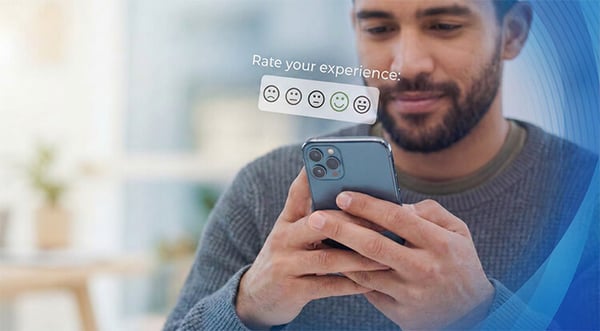
Making Feedback as Convenient as the Visit
A frictionless visit requires a frictionless feedback loop. You can't offer a seamless 10-minute video call and then ask the patient to complete a clunky 20-question survey. Feedback mechanisms must match the speed and ease of the experience itself. Modern platforms like Macorva use mobile-first Surveys with Tappable Attributes, allowing patients to provide rich, qualitative context in seconds by simply tapping descriptors like "Audio Lag," "Easy Login," or "Helpful Explanation," without the burden of typing long responses. This respects the patient's time while gathering the actionable data needed to identify operational issues and improve the digital workflow.
New Rule #2: Treat Telehealth as a Full Journey (Pre, During, and Post)
One of the most common mistakes in virtual care is treating the video call as a single, isolated event. However, with clinicians already overwhelmed by demands for personalized care, they cannot be expected to manually manage every touchpoint surrounding that call. To solve this, leading organizations are turning to what Stanford Medicine has termed “digitally enabled care” to augment patient services across the whole patient journey. For the patient, the experience begins the moment they decide to seek care and does not end until their questions are answered. A truly successful digital strategy supports this entire lifecycle.
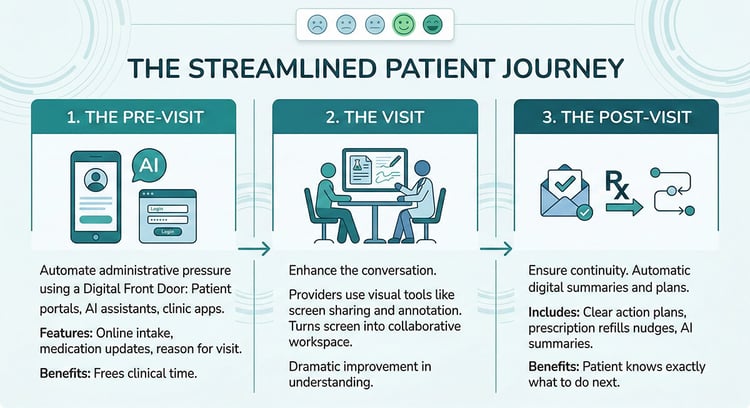
A holistic journey requires a deliberate focus on three distinct phases:
- The Pre-Visit: The pre-visit can now be largely automated to relieve administrative pressure. Use your "Digital Front Door", a technology entryway comprising patient portals, AI assistants, and clinic apps, to connect patients to services before they see a clinician. AI tools can handle online intake, update medication requests, and log the reason for the visit. This frees up valuable clinical time to focus on care, not administration.
- The Visit: Technology should enhance the conversation, not just transmit it. Equip providers with tools like screen sharing to review lab results visually or annotation tools to explain complex diagnoses. This turns the screen into a collaborative workspace and dramatically improves patient understanding.
- The Post-Visit: The journey often breaks down after the camera turns off, leaving patients feeling uncertain about their next steps without a physical discharge paper. To avoid this, automatically send clear action plans, digital nudges for prescription refills, and AI-generated summaries of the doctor’s instructions so patients know exactly what to do next.
Closing the Loop with Automation and Service Recovery
The post-visit is also the most critical moment to close the feedback loop. Automated workflows can trigger an SMS survey the second a visit ends, capturing impressions while they are fresh. In addition, this immediacy powers Service Recovery. If a patient reports a technical issue, that feedback can be routed directly to IT instantly, ensuring the glitch is fixed before the next patient logs on.
New Rule #3: Measure What Matters (Beyond HCAHPS)
You can't fix what you don't measure, and traditional healthcare surveys weren't built for a digital world. A patient might rate the doctor highly but rate the experience poorly because the video lagged, a nuance HCAHPS surveys often miss. To truly understand the digital experience, organizations need a new set of metrics.
To get a complete picture, organizations need to track metrics across three key categories:
- Technical Metrics: Track connection stability, audio and video quality, patient drop-off rates, latency, and mid-visit disconnections.
- Operational Metrics: Track ease of joining calls, patient wait times, reconnection frequency, time to start, reconnection duration, and appointment overruns.
- Experiential Metrics: Track the clarity of the patients’ next steps, the clinician’s ‘webside’ manner, and loyalty indicators such as the Net Promoter Score (NPS) and the intent to reuse the service.
Turning Data into Action with AI
Collecting this data is only the first step. The real challenge is finding the signal in the noise. Managers don't have time to manually read thousands of comments to find patterns. Using AI-powered analysis, platforms like Macorva scan this unstructured data at scale and identify trends. For example, if multiple patients mention "doctor looked distracted" or "background was noisy," the AI flags this and suggests actionable next steps. This allows leadership to provide targeted coaching or improve best practices without relying on manual review.
Key Takeaway
HCAHPS feedback strategies were not conceived with telehealth in mind. They provide a good basis for measuring patient perspectives, but they should be supplemented by knowledge of the benefits and limitations of telehealth care.
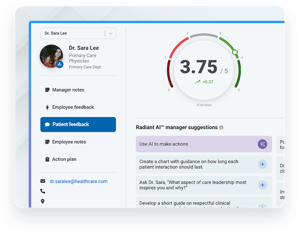
Turn every patient interaction into positive outcomes
New Rule #4: Design for Universal Access
A five-star digital experience is meaningless if a significant portion of your patient population can't access it. A "digital-first" strategy must not become a "digital-exclusive" one. If a platform requires the latest smartphone or high-speed broadband, it alienates vulnerable populations and skews satisfaction data, leaving you with an incomplete picture of your performance.
Building an inclusive platform involves three key strategic pillars:
- Interoperability: Stop forcing patients to download standalone telehealth apps. Instead, integrate virtual visits directly into the platforms they already use, such as existing patient portals (e.g., MyChart, HealtheLife). This lowers the barrier to entry significantly.
- Caregiver Integration: Often, the most effective bridge for the digital divide is a family member. Ensure your platform allows a third party, a daughter, son, or translator, to easily join the visit link from a separate location to assist the patient.
- Multilingual by Default: Don't make language an afterthought. Digital interfaces should auto-detect language preferences or offer one-click translation, rather than forcing non-English speakers to navigate complex menus.
Ensuring Every Voice is Heard
Inclusivity must extend to how you listen. To hear from everyone, organizations should use a multi-channel feedback strategy that meets patients where they are. This includes offering feedback options via email for desktop users and direct links within the patient portal. For patients with lower tech literacy or limited data plans, SMS feedback loops serve as an accessible alternative. Text messages have high open rates and work on basic mobile phones, ensuring that you capture insights from the entire patient population, not just the most tech-savvy.
Key Takeaway
Accessibility is more than a one-time fix; it’s an ongoing relationship between clinics and the patient demographics they hope to serve. The telehealth patient experience is not always dependent on the visit itself, but may rely on the patient’s access to technology, translation services, and browser applications that remove barriers to care.
New Rule #5: Build Trust Through "Webside Manner"
Building trust first requires acknowledging the difference between trust and satisfaction. While patients can offer feedback that indicates satisfactory results, more effective trust indicators, such as return visits, recommendations, and treatment follow-through, require additional feedback criteria. In a virtual setting, without the reassuring presence of a physical exam, a clinician's "webside manner", their ability to convey empathy, confidence, and focus through a screen, becomes the primary driver of patient trust.
Improving webside manner is a combination of training and technology-supported feedback:
- Connection Training: Train providers on the nuances of virtual communication, such as making eye contact with the camera lens (not just the screen) and using active listening cues that translate digitally.
- Personalization: Humanize the encounter by having providers reference patient history and labs to show continuity of care and demonstrate that the patient is known and understood.
- Transparency: Be upfront about the process. Explicitly communicate privacy safeguards to reassure patients who may be skeptical of digital channels.
 Supporting Clinicians to Improve the Patient Connection
Remote work can be isolating for clinicians, leading to burnout that directly impacts their empathy and performance. Provider scorecards are a vital tool for countering this. Platforms like Macorva push AI-generated feedback reports directly to a clinician’s email or Teams, highlighting specific patient praise to boost morale and providing personalized, data-driven insights for self-correction.
Beyond individual performance, unified dashboards allow leaders to observe the weak points of their telehealth system satisfaction ratings by correlating patient experience and employee experience. Often, a dip in scores is not a failure of clinical care, but a symptom of high clinician burnout or a demographic tech-literacy gap. Without this actionable pattern analysis, clinics risk overcorrecting in the wrong areas while leaving the true area of concern exposed.
Conclusion: Thriving in the New Era
Telehealth is no longer about just establishing connectivity; it is about creating a care pipeline that is seamless, inclusive, and empathetic. To be positioned for success in 2026, organizations must treat the digital experience with the same dedication as the in-person one. It is a standard of care that patients are already ranking just as effective as in-person visits.
Healthcare leaders should start by auditing their current digital journey to find the friction points. By implementing a real-time listening engine, organizations can understand exactly where the experience is breaking down and take immediate, data-driven action to fix it.
Explore our Patient Experience Solutions to see how AI-powered feedback helps clinics adapt to the changing standards of patient care.